
Good project governance is not about producing more documents. It is about making sure the right information is captured, maintained and used to support decisions.
Many projects have plans, registers and reports, but those documents often operate independently. Information is duplicated, updates become inconsistent and important decisions are made without a clear audit trail.
A well-structured project document system creates one connected source of truth. It gives the project team clarity, provides stakeholders with confidence and helps governance groups focus on decisions rather than searching for information.
Start with the purpose of each document
Every project document should have a defined purpose. Before introducing a new template or register, establish:
• What information it captures
• Who owns and updates it
• How frequently it should be reviewed
• Who needs to see it
• Which decisions or activities it supports
If a document has no clear owner or review point, it will quickly become outdated. If the same information appears in several places, the project team may no longer know which version is accurate.
Build a practical document structure
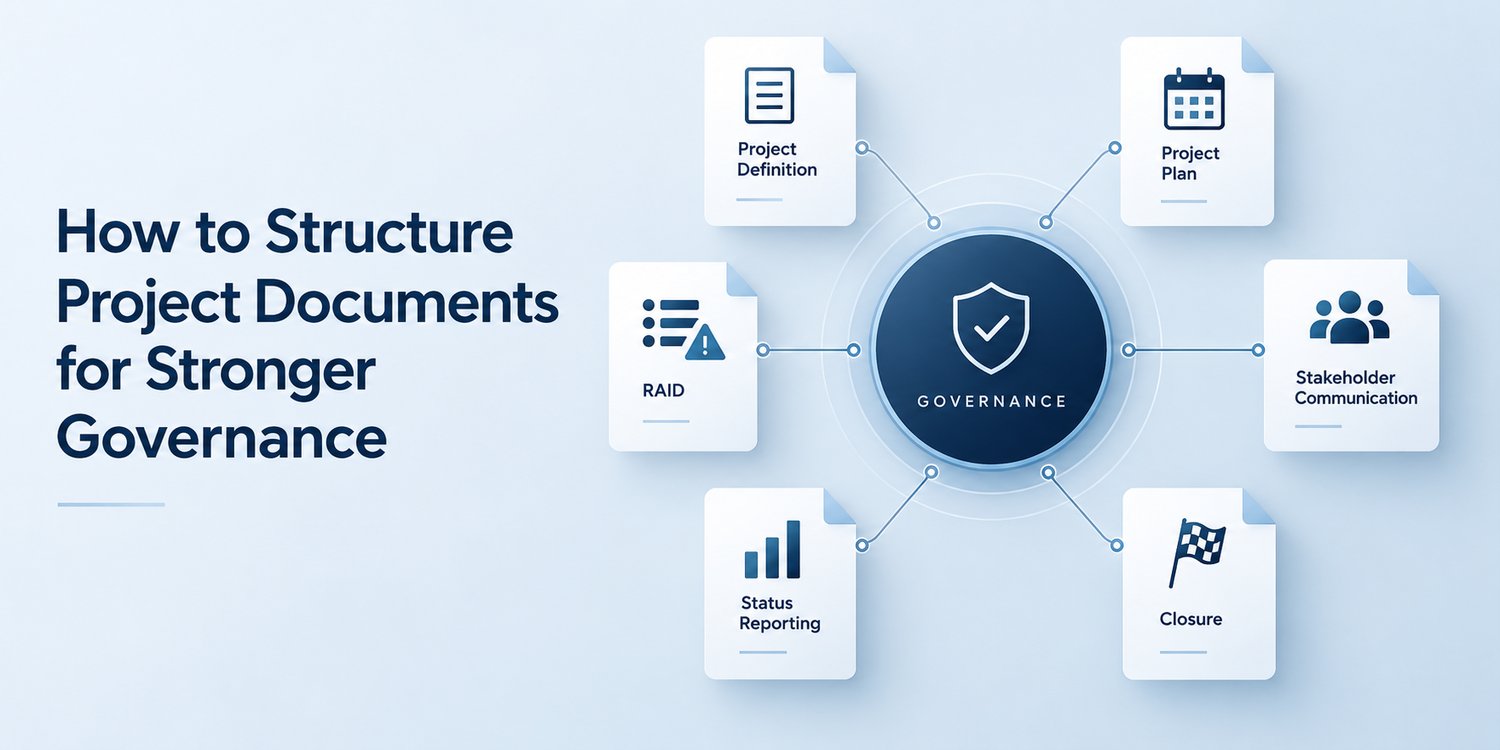
Most projects benefit from a core set of connected documents covering the full delivery lifecycle.
1. Project definition
The project charter, brief or initiation document should establish why the project exists, what it will deliver and how success will be measured.
It should provide clarity on scope, objectives, governance, responsibilities, assumptions and constraints.
2. Project plan
The project plan translates the agreed objectives into activities, milestones, dependencies and delivery dates.
It should remain connected to the RAID register. A delayed dependency, emerging risk or unresolved issue may affect the plan and should not be managed separately.
3. RAID register
The RAID register brings together risks, assumptions, issues and dependencies requiring active management.
Each entry should have a clear owner, response or action, target date and current status. The register should also define when an item needs to be escalated.
A RAID register should support conversations and decisions. If it becomes a long list that is reviewed without meaningful action, it is no longer serving its purpose.
4. Stakeholder and communication records
Stakeholder analysis helps the project understand who is affected, their level of influence and how they should be engaged.
The communication plan should then translate that analysis into specific activities, owners, channels and frequencies.
5. Change and decision records
Changes and decisions should be recorded separately but linked to the relevant risks, issues, costs, benefits and milestones.
This creates traceability and prevents the project team from relying on meeting notes or individual recollection.
6. Status reporting
A project status report should summarise information already maintained elsewhere. It should draw from the plan, RAID register, actions, milestones, budget and change records.
Reporting should not require the project manager to recreate the project’s position every week. A connected document structure makes reporting faster and more reliable.
7. Closure and handover records
Closure documentation should confirm what was delivered, what remains outstanding and who will take ownership after the project ends.
It should also capture lessons, approvals, operational responsibilities and any benefits that still need to be measured.
Create a clear review rhythm
Documents only support governance when they are reviewed consistently.
A practical rhythm could include:
• Regular project team reviews of actions, milestones and RAID items
• Scheduled status reporting for sponsors and stakeholders
• Governance meetings focused on decisions, exceptions and escalations
• Formal reviews at key stages or approval points
• A structured closure and handover process
The frequency should reflect the project’s size, pace and level of risk. Governance should be proportionate rather than burdensome.
Keep the system proportionate
A small internal project will not need the same level of control as a complex programme involving multiple organisations.
The objective is not to complete every available template. It is to select the documents that support delivery, accountability and decision making.
A useful test is to ask:
• Does this document help someone understand, manage or decide something?
• Is the information maintained in one clear location?
• Is there an identified owner?
• Is it reviewed at the right point?
• Does it connect with the wider project record?
If the answer is no, the document may need to be simplified, combined or removed.
Structure creates confidence
Strong project governance comes from clarity and consistency. When documents are connected, responsibilities are visible and information is kept current, teams spend less time searching for answers and more time managing delivery.
Practical tools to support stronger governance
The Milenovo Project Management Toolkit provides a connected collection of editable Word, Excel and PowerPoint resources designed to support the complete project lifecycle.
For teams looking specifically to strengthen the management of risks, assumptions, issues and dependencies, explore the RAID & Risk Management Toolkit.
Tools Today. Impact Tomorrow.